Your Kid Has Tried Six Sports and Loves None of Them. Here's Why.
After years of coaching youth badminton, I've seen it all — parents bursting with enthusiasm on day one, kids quitting three months in because nobody hit the brakes on expectations. This isn't a sales pitch. It's an honest conversation about youth sports, child development, and what we actually want for our kids when we sign them up for yet another activity.
01 Parents Mean Well — So Where Does It Go Wrong?
Let's be clear: almost every parent who signs their kid up for badminton has great intentions. They want their child to be active, build discipline, develop social skills, and stay off screens. All of that is completely valid. The problem isn't the motivation — it's the strategy.
❌ Mistake #1: More Activities = Better Development
Badminton this semester, ping-pong next fall, soccer after that, then basketball — you get the idea. The kid has technically "tried" six sports, but hasn't genuinely learned a single one. No real skill, no real confidence, no real love for any of it. Parents then scratch their heads wondering why their child seems indifferent to sports altogether. It's not the kid's fault. Nothing was ever given the chance to stick.
❌ Mistake #2: Ten Lessons Should Be Enough to Play
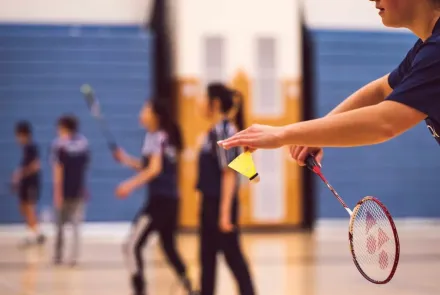
This one comes up constantly. A parent signs their kid up for a ten-session intro course and fully expects their child to be rallying back and forth by the end of it. Badminton doesn't work that way — and honestly, no sport worth learning does. Ten lessons is enough to start building basic hand-eye coordination with the shuttle. That's it. And that's perfectly okay, as long as you know it going in.
❌ Mistake #3: My Kid Is Smart, So They'll Pick It Up Fast
Academic intelligence and athletic coordination are two completely different systems. The body doesn't care how well your kid does on tests. Ball sense, footwork, and racket timing are neuromuscular skills — they're built through repetition, not reasoning. A straight-A student still needs the same number of practice reps as everyone else. There are no shortcuts here.
❌ Mistake #4: If They're Frustrated, Just Let Them Quit
Every skill has a wall — that brutal stretch where progress stalls, frustration peaks, and nothing feels fun. In badminton, it usually hits around months two through four. Pulling a kid out right at that moment doesn't just cost them a sport. It quietly teaches them that walking away when things get hard is an acceptable option. That's a lesson that sticks way beyond the court.
02 Why Is Badminton Harder to Learn Than Most Racket Sports?
Parents often compare badminton to tennis or ping-pong and assume the learning curve is similar. It isn't. In tennis, the ball bounces off the ground — that bounce gives kids a moment to reset and find it. In ping-pong, everything happens on a flat table surface. The ball behaves predictably. Badminton is an entirely different animal. The shuttle flies in every direction — deep clears, tight net drops, flat drives, overhead smashes — each with a completely different speed, arc, and landing zone. Kids have to track a three-dimensional object moving at wildly different speeds across the full court, all while moving their feet and swinging a racket. That's a serious cognitive and physical demand.
Worth knowing: Badminton is widely recognized as one of the most demanding racket sports for hand-eye coordination, reaction time, and spatial awareness. Elite players react in as little as 100–120 milliseconds — on par with top combat athletes. For a kid with average coordination, making consistent contact with the shuttle is a genuine accomplishment. Treat it like one.
| Sport | Ball/Shuttle Behavior | Beginner Difficulty |
|---|---|---|
| 🏓 Ping-Pong | Bounces off table, short range, predictable path | Moderate |
| 🎾 Tennis | Bounces off ground, mostly two-dimensional movement | Moderate |
| 🏸 Badminton | Three-dimensional, all directions, no bounce, highly variable speed | Higher — but the payoff is bigger too |
None of this means badminton is the wrong sport for kids. If anything, the higher demand is precisely why long-term training delivers such strong results in coordination, reaction speed, and physical fitness. But parents need to go in with realistic expectations: the runway is longer, and it requires more patience than most people plan for.
Real sports development isn't about sampling everything on the menu. It's about helping your kid fall in love with something — and finding out what they're capable of when they actually stick with it.
03 The Right Sports Plan: Go Deep, Not Wide
Here's the framework I recommend to parents: pick one to two sports for genuine, long-term development — not a new one every semester. A solid combination is one precision sport (badminton, tennis, or ping-pong) paired with one team or contact sport (basketball, soccer, or volleyball). That mix develops fine motor skills, cardiovascular fitness, and the ability to work with others — pretty much everything you'd want.
A practical example: Badminton as the primary sport, pursued consistently over a year or more, paired with basketball or soccer on the side. The goal is simple — get your kid to the point where they genuinely want to play on their own, without being pushed. One sport at that level beats five sports at the surface level every single time.
04 What Kids Actually Gain From Long-Term Badminton Training
These aren't marketing talking points. They're backed by sports science research and years of watching kids develop on the court.
🧠 1. Sharper Focus and Better Academic Performance
The split-second decision-making badminton demands — read the shuttle, choose a shot, move your feet, execute — is essentially high-intensity brain training. Research consistently links this type of neurological activity to improvements in working memory, sustained attention, and executive function. These are the exact skills that show up in classroom performance.
⚡ 2. Faster Reflexes and Full-Body Coordination
Consistent badminton training measurably improves reaction time and whole-body coordination. And these gains transfer. Kids who train regularly tend to move better in other sports, handle unexpected physical situations more gracefully, and develop a general athleticism that serves them well across the board.
💪 3. Real Cardiovascular Fitness
A competitive badminton match can cover more than six kilometers of movement, with the heart rate staying in the aerobic training zone throughout. For kids who spend the bulk of their day sitting at a desk, badminton is one of the most time-efficient ways to build genuine cardiovascular health — and it doesn't feel like exercise. It feels like playing.
🧘 4. Emotional Regulation and Mental Toughness
Badminton is an immediate sport. Every point is won or lost right in front of you, with no teammates to share the moment. Kids learn — through real experience, not lectures — how to shake off a bad point, refocus under pressure, and keep their composure when the score isn't going their way. That kind of mental toughness doesn't come from a classroom or a self-help book. It comes from being in the game.
🤝 5. Social Skills and Sportsmanship
Badminton has a strong culture of mutual respect. Kids learn to acknowledge good shots from opponents, call lines honestly, and handle wins and losses with grace. For only children or kids who spend a lot of time in structured, adult-supervised environments, the peer dynamic of competitive play is genuinely valuable social development.
🌱 6. A Sport for Life
This might be the most underrated benefit. Badminton is legitimately playable from age six to eighty. An adult who actually knows how to play — not just swing at a backyard birdie, but really play — has a portable, low-cost, high-enjoyment fitness habit they can take anywhere in the world for the rest of their life. That's a long-term return on investment that's hard to beat.
05 Four Practical Tips for Parents
✅ Tip 1: Commit to at Least Six Months Before You Evaluate
The real benefits of any sport — genuine skill, real enjoyment, built-in confidence — don't show up in six weeks. Give it at least six months. The target isn't "can my kid hit a shuttle." The target is "does my kid actually want to go to practice." Get there first, then reassess everything else.
✅ Tip 2: Stop Comparing Your Kid's Progress to Other Kids
Coordination develops on individual timelines. Some kids are making clean contact by week six. Others need five months. Neither one says anything meaningful about your child's potential — only about where they are right now. Comparing kids at this stage does more harm than good, for them and for you.
✅ Tip 3: Hit Around With Them Outside of Class
Class time alone isn't enough to build real ball sense quickly. Twenty or thirty minutes of casual hitting in the backyard or at a local court two or three times a week makes a dramatic difference in how fast kids develop. It also happens to be some of the best quality time you can spend together — no phones, no distractions, just playing.
✅ Tip 4: When They Want to Quit, Talk to the Coach First
Kids say "I don't want to go" for a lot of different reasons, and frustration with progress is only one of them. Before you pull them out, have a conversation with the coach. Very often, one session where something clicks — one rally that actually goes back and forth, one smash that lands right — is enough to completely flip a kid's attitude. Don't make a permanent decision based on a temporary feeling.
06 The Bigger Picture: What Are We Really Trying to Build?
Here's what I actually believe after years of coaching kids: you're not sending your child to badminton to make them an athlete. You're sending them to develop a complete person — someone who doesn't fall apart under pressure, who gets back up when they lose, and who can find genuine satisfaction in working hard at something difficult.
Every swing of the racket, every drill, every frustrating session where nothing goes right — it's all telling your kid something important: your body is trainable, your skills are improvable, and effort actually leads somewhere. That belief is worth more than any trophy. It shows up in school, in work, in relationships, in every hard thing they'll face for the rest of their lives.
We're not trying to raise champions. We're trying to raise kids who know what it feels like to work at something and get better at it. If badminton can be that thing for your child — even just one of those things — that's a win worth every ounce of patience it takes to get there.
🏸 Thanks for reading. If you have questions about your child's progress or want to talk through the right training plan, reach out to our coaching staff directly — we're always happy to chat.